

Setl Group was founded in 1994 and has grown over 30 years to become a leader in the new housing market. Setl Group develops a wide range of residential projects — from comfort-class housing and redevelopment to exclusive premium and business-class properties. During its activity, the company has delivered 372 residential buildings, which is more than 197,000 apartments. Every year, the company delivers over 1 million square meters of new housing. In 2024, the Group delivered over 1.13 mln sq. m. of residential property. The Group’s core business areas include design, construction, and comprehensive urban development. For such a large developer, the issue of using digital tools to improve the efficiency of business processes is acute. Building Information Modeling (BIM) technologies are of paramount importance.
Recently, BIM has become increasingly common in the design of residential, social, and industrial facilities. Market leaders are going digital, setting best practices for other construction and architectural design companies to follow. Pavel Sugak, Head of the Setl City Architecture Bureau (part of Setl Group), shares how the company uses Building Information Modeling (BIM) technology in residential design and how the Renga BIM system supports this process:
- Today, our architectural bureau employs about 100 specialists, although it was established relatively recently. From the outset, we set out to apply new design approaches and technologies to streamline and accelerate the process. 2D modeling is still widespread in our field, and skilled 2D professionals are in abundant supply. But 2D modeling has a number of significant disadvantages.
Setl Group is a forward-thinking, high-tech company constantly seeking digital tools to meet new challenges. Naturally, we began the transition to Building Information Modeling. We chose the Renga BIM system and proved it to be both practical and effective.
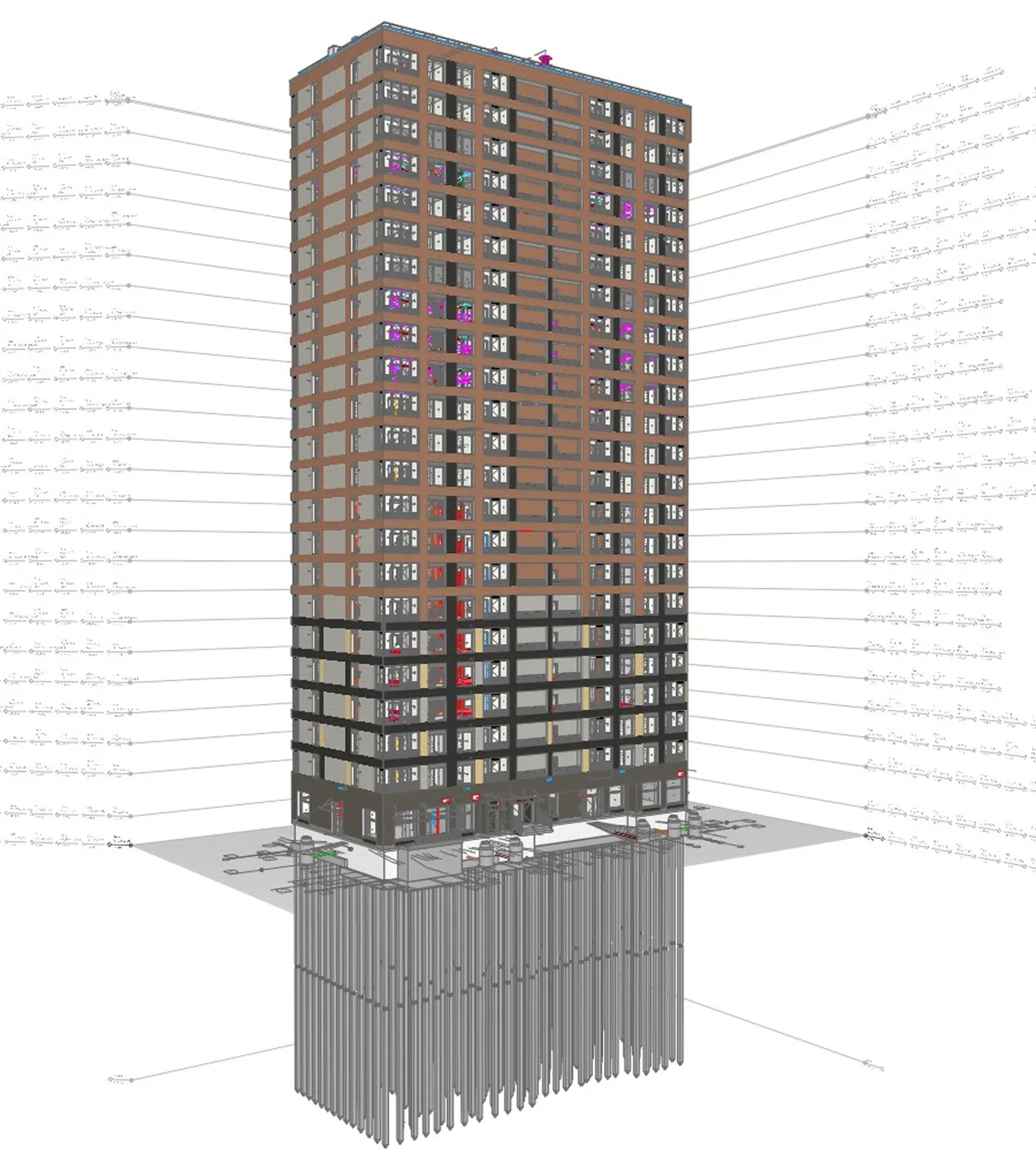
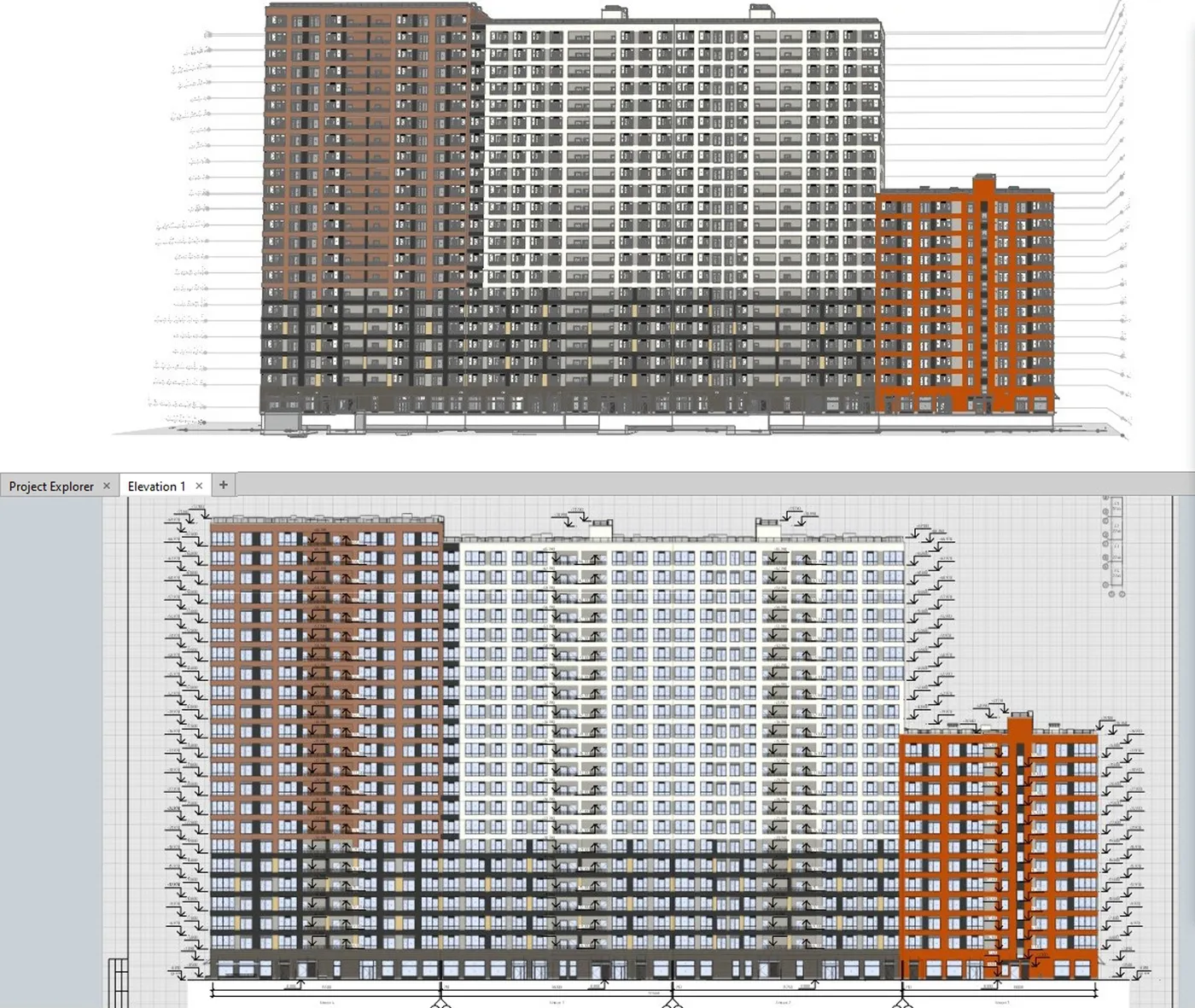
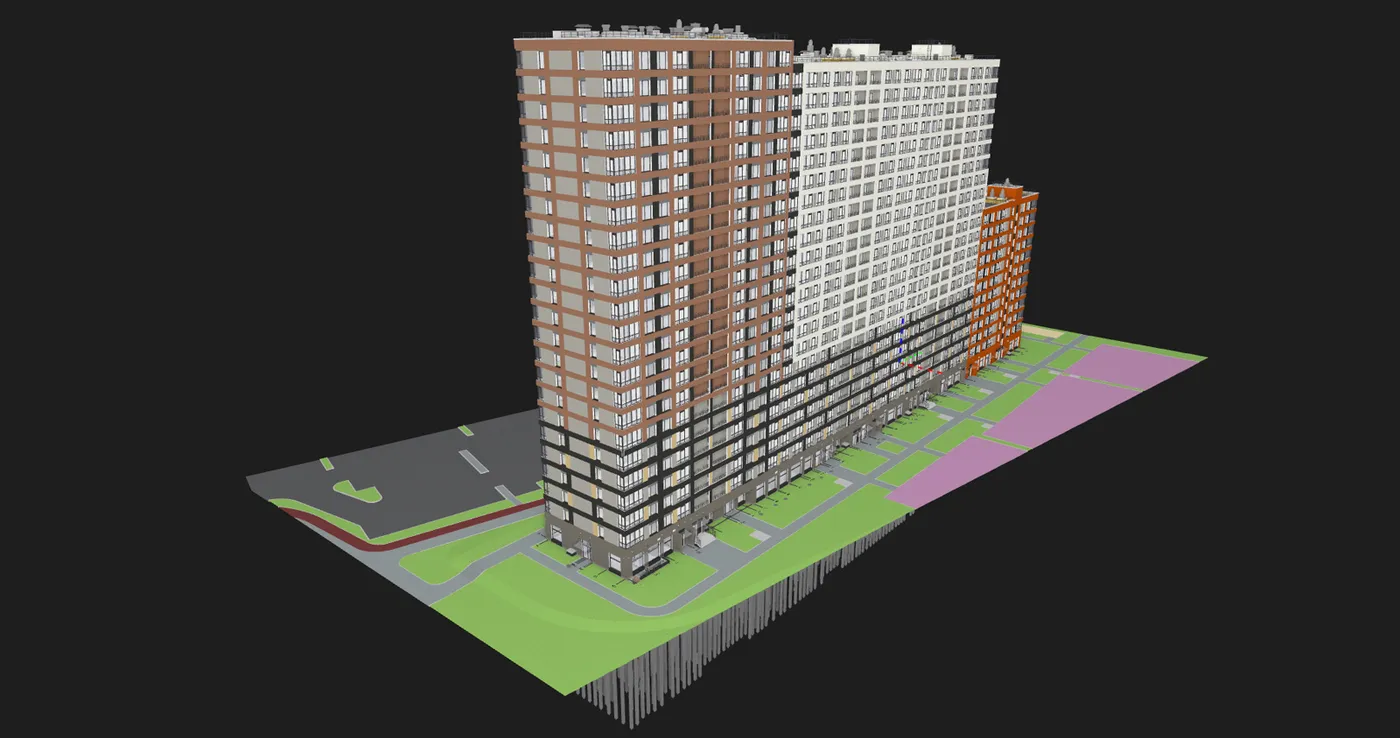
Our first project fully designed in Renga was an apartment building, a part of the City of Stars apartment complex (1.7 mln sq. m.) for 46,800 residents. It’s a four-entrance building with 12, 22, 22, and 23 stories, respectively. It has a total floorspace of 43,000 sq. m. and includes 771 apartments.
There is a full mechanical basement with water meters, fire pumps, cold water supply, heat station, cable inlets, and electric switchboards.
The ground floor (0,000 elev.) houses commercial premises, the HOA office, and the control room. The grounds are pedestrian-only. Each building entrance is a pass-through. All entrances are at ground level and fully accessible to people with disabilities. Apartments are located on the first floor and up.
Getting Started with Renga
The pilot project in Renga started in September 2023 with the training of the 1st integrated design team.
In just a few weeks, as early as the beginning of October, the architects started working in Renga, despite having no prior experience with the system. Therefore, we can state that the Renga learning curve is very low.
ASCON employees delivered the training. A team of 15 architects carried out the pilot project from conceptual design to construction documentation release.
In April 2024, the project deliverables were presented for evaluation, and Renga was found to have handled the task perfectly.
We identified several critical features that were not fully available in Renga at the time, and the developers promptly added the necessary functionality.
The key takeaways from the pilot project (conceptual design stage) are:
- Formation of a Renga design team
- Training of the team members and project managers
- Finding that the number of architects required for 3D modeling equaled that for 2D drafting.
- Finding that a new BIM department is needed in the Architect Bureau to support BIM and 3D projects.
- We have developed core component/assembly libraries and drawing templates.
- We have defined the structure of the project, model files, and folders.
- We use the Pilot-BIM environment with Renga.
- Renga functionality requiring enhancement was identified to improve performance.
We concluded that project documentation and digital information models (DIMs) can be created in Renga. After the conceptual design was approved, the pilot project was expanded to include two more buildings of the City of Stars residential complex. By the beginning of the detailed design stage, we had modeled 13 apartment building sections in Renga.
We prepared the detailed design documentation package in 4 months. We also received the employer’s information requirements (EIR). We worked on the detailed design based on the conceptual BIM model to meet these requirements. New teams now design using the experience we gained.
To accelerate the design, we have made a design template for new projects and are still refining it to include DIM styles, materials, and drawing/BOM layouts.
Architectural Solutions:
- The DIM is divided into sections and complies with the employer’s information requirements (EIR).
- The detailed documentation package is auto generated from the DIM.
- The BOMs are also auto generated from the DIM.
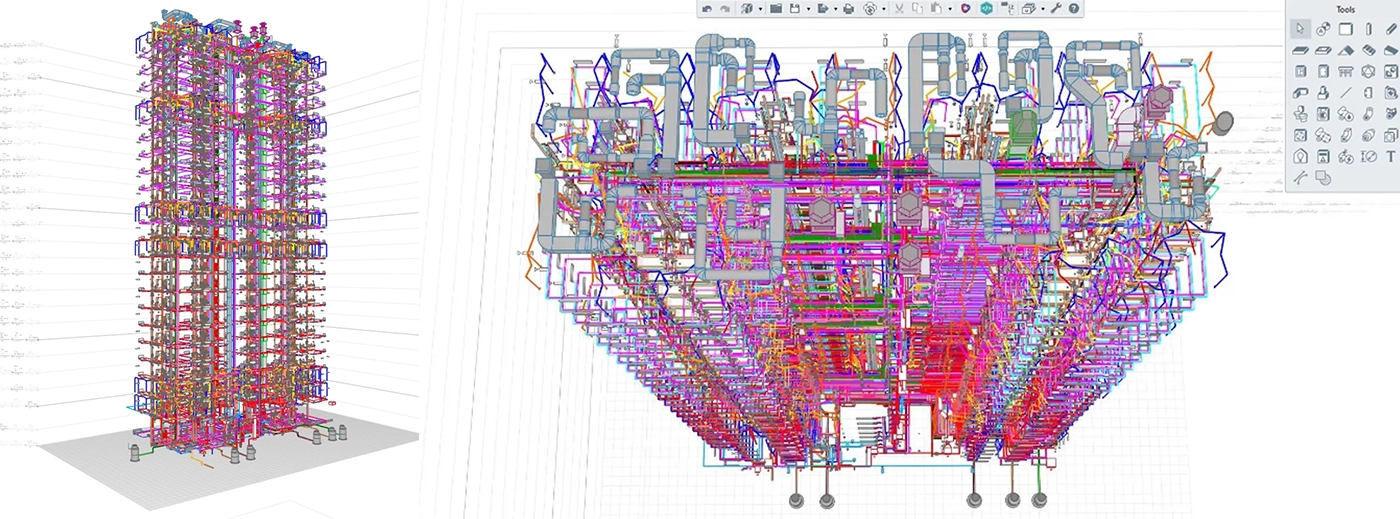
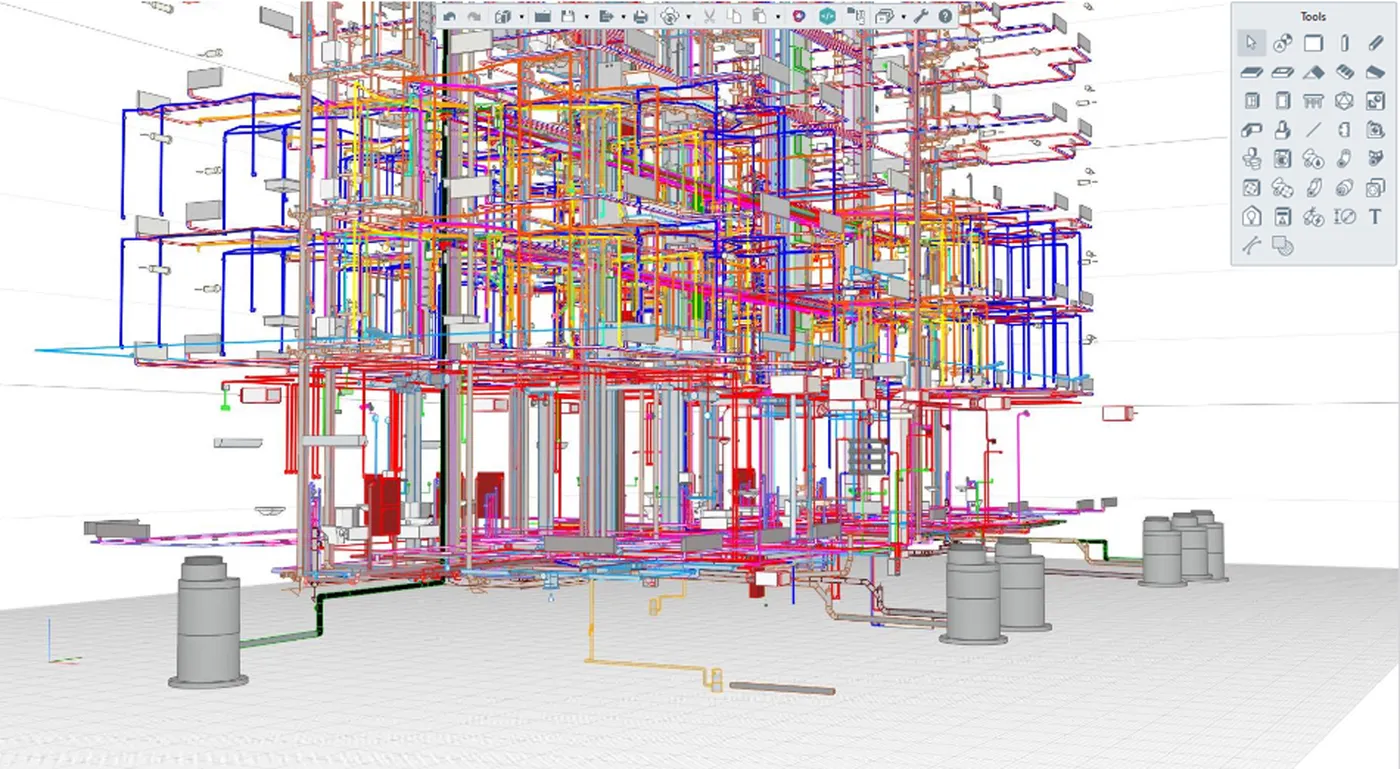
Engineering Solutions:
- All architectural and engineering solutions are integrated into a single DIM.
- All in-building utilities are modeled in 3D.
- Drawings and axonometric views are auto generated from the DIM.
- The BOMs are also auto generated from the DIM.
- The detailed design packages were generated.
Construction Solutions:
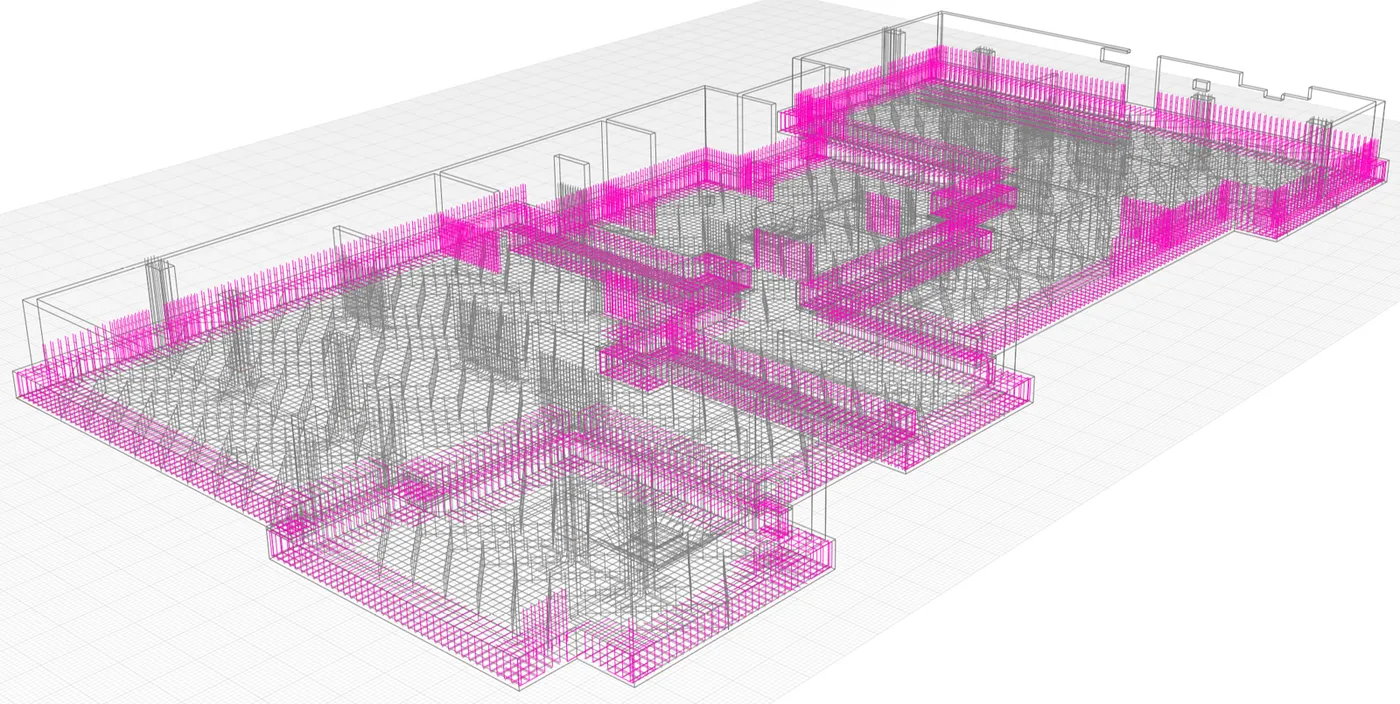
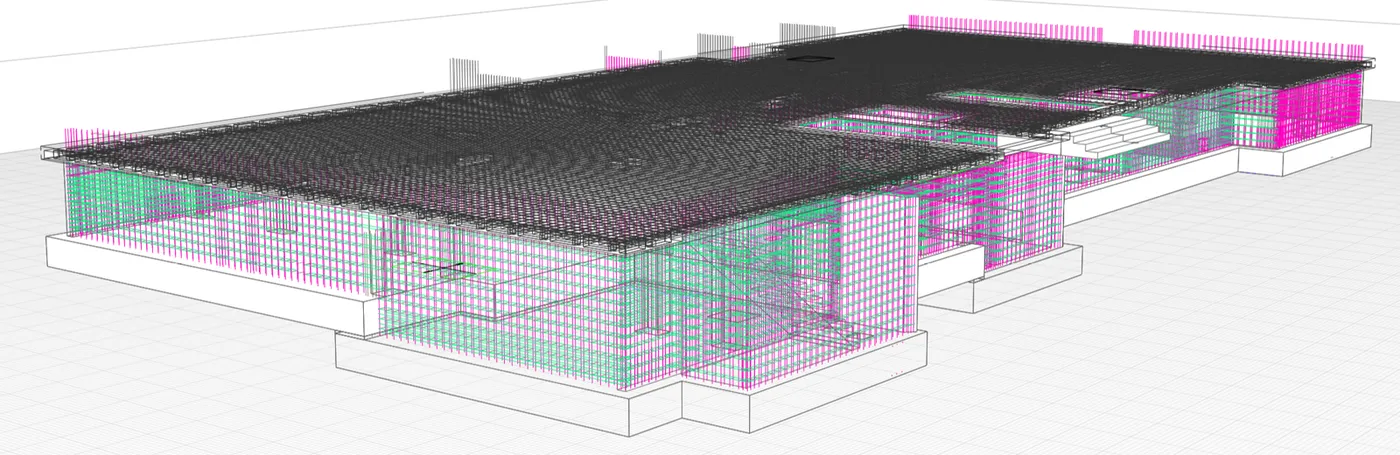
- Reinforced concrete structures are modeled for one section of the building.
- The reinforcement layout is designed in 3D using the Renga tools.
Apartment Design in Renga
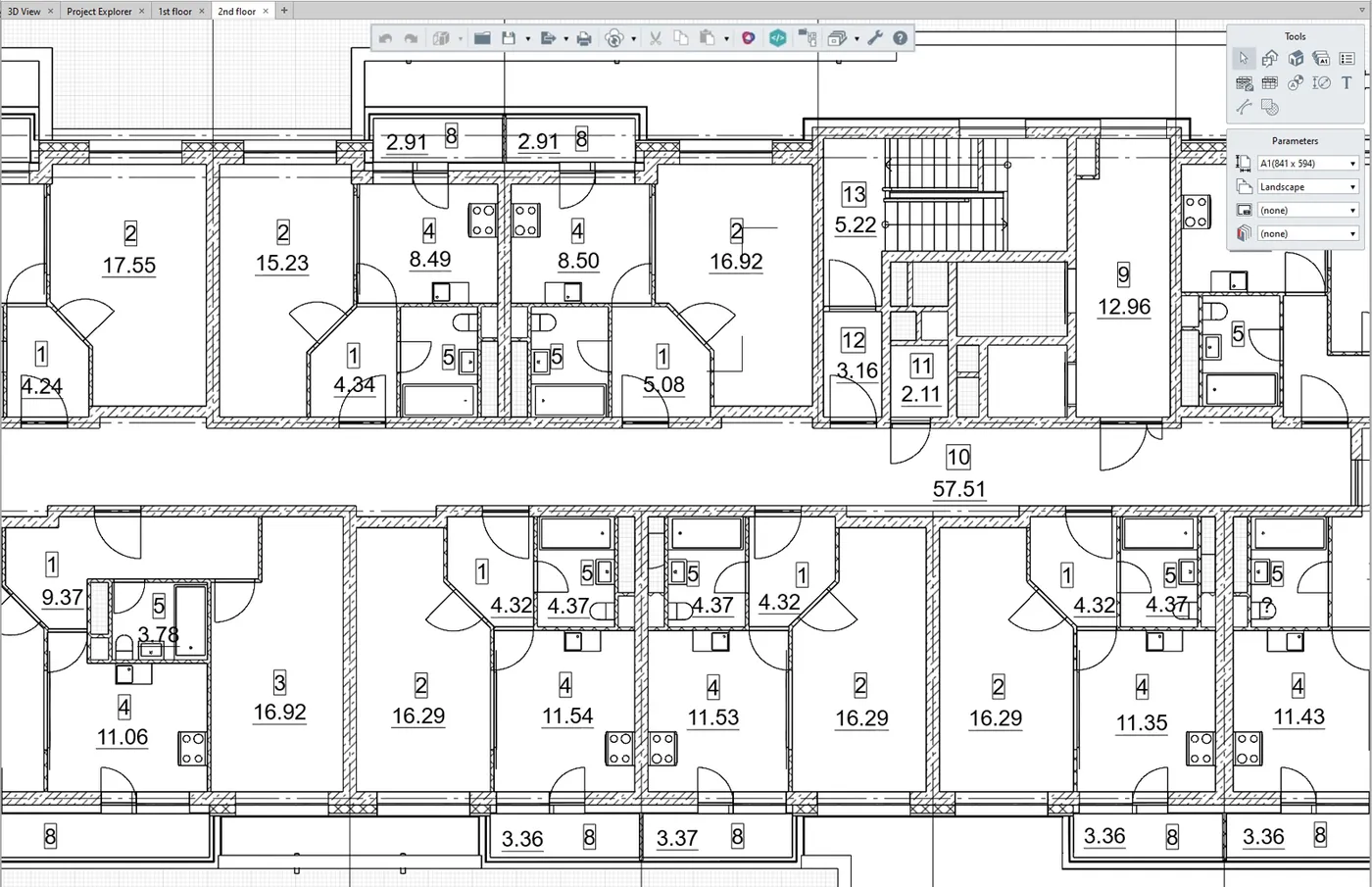
Every apartment in a residential building must exactly comply with the customer-provided layout. We use the following Renga tools for all apartment floor area calculations and drawing generation: Room, Element, BOM, and Marker. To calculate the usable, gross, and total areas of apartments, we use custom properties and equations.
Apartments are represented by 3D elements. In BOMs, we group all premises and apartments by the "Apartment number” property. This gives us a clear picture of the floor areas. The aggregated areas can be copied from the BOM to the custom properties of each apartment element.
Quantity Takeoffs
A key customer’s requirement for the information model is auto quantity takeoff using the Renga model data with the specified level of detail. This is included in the EIR for the BIM model. According to these requirements, all finishes (interior wall finishes, floors, ceilings, exterior facade finishes) must be modeled separately from the building structures. The requirements also specify the attributes of the BIM model objects as needed to generate a bill of quantities (BoQ) and group them as needed. The quantities are mostly grouped by floor and section.
To export data from Renga, we save the BIM model in the IFC4 format. This functionality in Renga works well; we have not had any problems with the export feature.
The vendors responded promptly to our requests for new functionality. For instance, following our request, they enabled the export of only visible objects to the IFC format.
The detailed documentation package includes a room finish schedule. It is also generated in Renga from the finish elements using the BOM and custom attributes and then exported to CSV.
Another advantage of Renga’s BOMs is that they are populated from the BIM model and auto updated as the model changes. Since each section of the building is modeled individually, the room finish schedule includes only one section. To generate a summary schedule for the entire building, we export the schedules for all sections into CSV and then consolidate them in an electronic spreadsheet. Consolidated schedules are great for BOM verification. In this way, we verify takeoff quantities for doors, windows, and other building components.
Pilot for Common Data Environment (CDE)
A common data environment (CDE) is another important aspect. We’ve opted for Pilot-BIM from ASCON and configured it as follows:
- We’ve created a work-in-progress workspace (for working files) and a shared workspace (for intermediate BIM model versions in IFC format to be reviewed by the customer).
- We’ve created the project folder structure.
- We’ve created a corporate BIM library with shared BIM catalogs.
- We’ve added project-wide BIM catalogs, regulations, and templates to the project folder.
- We check BIM models for clashes.
- We issue design assignments.
- We use the customer’s infrastructure for e-document exchange with the contractors.
BIM Catalogs: A Job for the New BIM Department
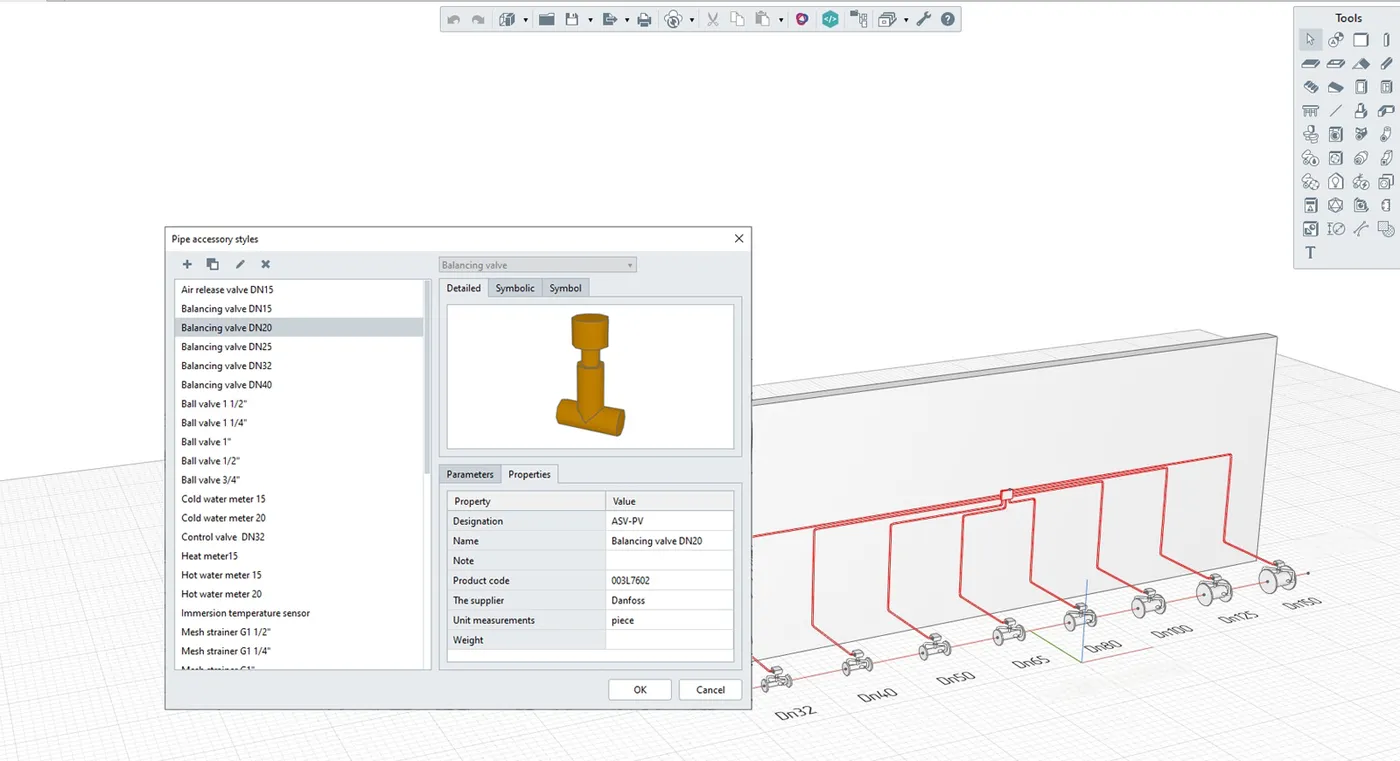
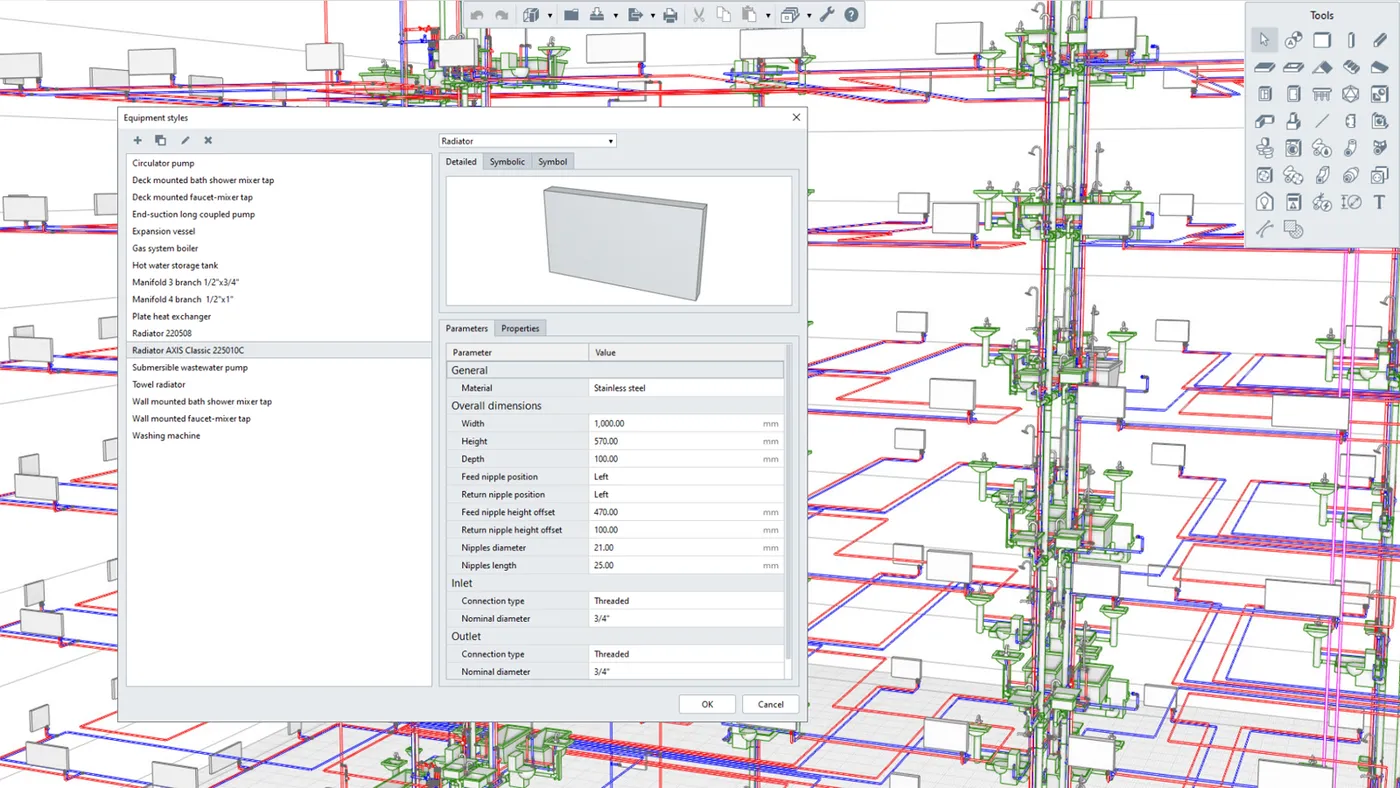
We have corporate standards covering engineering solutions and finishes by apartment class. These standards list the commercially available products and components we use. After the Renga deployment, we needed to convert these standards into BIM catalogs. Using the standard Renga tools, the BIM Department created catalogs for our designers fully compliant with the corporate finish standards.
Collaboration in Renga
One of the reasons for selecting Renga was its support for multi-user project collaboration. We urgently needed to accelerate the entire design process. We saw collaboration as a way to boost productivity.
Collaboration also helps us with large-scale projects. Renga tracks every change made to the project. We’ve set up a local search engine to monitor the progress in real time. Now we can:
- Track designer performance by project.
- Track work-in-progress and the latest project version saved on the server.
- Detect any remote connection issues.
- Detect potential conflicts when multiple designers edit a shared DIM.
Today, collaboration is a must. We’ve appreciated its benefits, and we are happy to know that this Renga functionality is expanding.
Conclusions
We opted for Renga about a year ago. It has been a long journey: we had to master 3D modeling and other design tools from scratch.
We can confidently state: Renga is the ideal choice for residential BIM projects.
Key Renga 3D Advantages:
- Errors are identified at early stages compared to manual drawings, resulting in high-quality projects.
- Design timeframes are similar to those in 2D and competing BIM software products.
- With Renga, management can track work-in-progress in real time and control the design process.
- We deliver information-rich models to other companies within the Group.
Models created in Renga are highly detailed and accurate. From the very beginning, we set very high quality standards. Now we are working on design acceleration. For this, a pre-design stage is needed to create BIM templates and product catalogs. We’ve created such templates, so new projects will be completed faster.
Currently, two design teams are using Renga. Three more teams from other Setl Group companies are taking their training sessions. We are still working on the City of Stars residential complex project. Two more large-scale projects will also be designed in Renga.
